All articles · 2026-05-13 · Taxation
Saving taxes as an entrepreneur: how to optimize your salary without fiscal risks?
The company is doing well, turnover is rising, profits look healthy on paper, but as soon as the money actually needs to go into private hands, frustration arises. Taxes, social contributions, dividends, pension products, reserves, optimization structures… suddenly every decision seems simultaneously financially and fiscally loaded. And that's often where things go wrong.
By Jan Hermans, CEO & founder of Lyff.
The company is doing well, turnover is rising, profits look healthy on paper, but as soon as the money actually needs to go into private hands, frustration arises. Taxes, social contributions, dividends, pension products, reserves, optimization structures… suddenly every decision seems simultaneously financially and fiscally loaded.
And that's often where things go wrong.
Because the deeper entrepreneurs delve into salary optimization, the more conflicting advice they receive. One accountant emphasizes dividends, another advisor swears by IPT (Individual Pension Commitment) accumulation, while someone online claims that a low salary is the only rational choice for a self-employed person with a company (vennootschap).
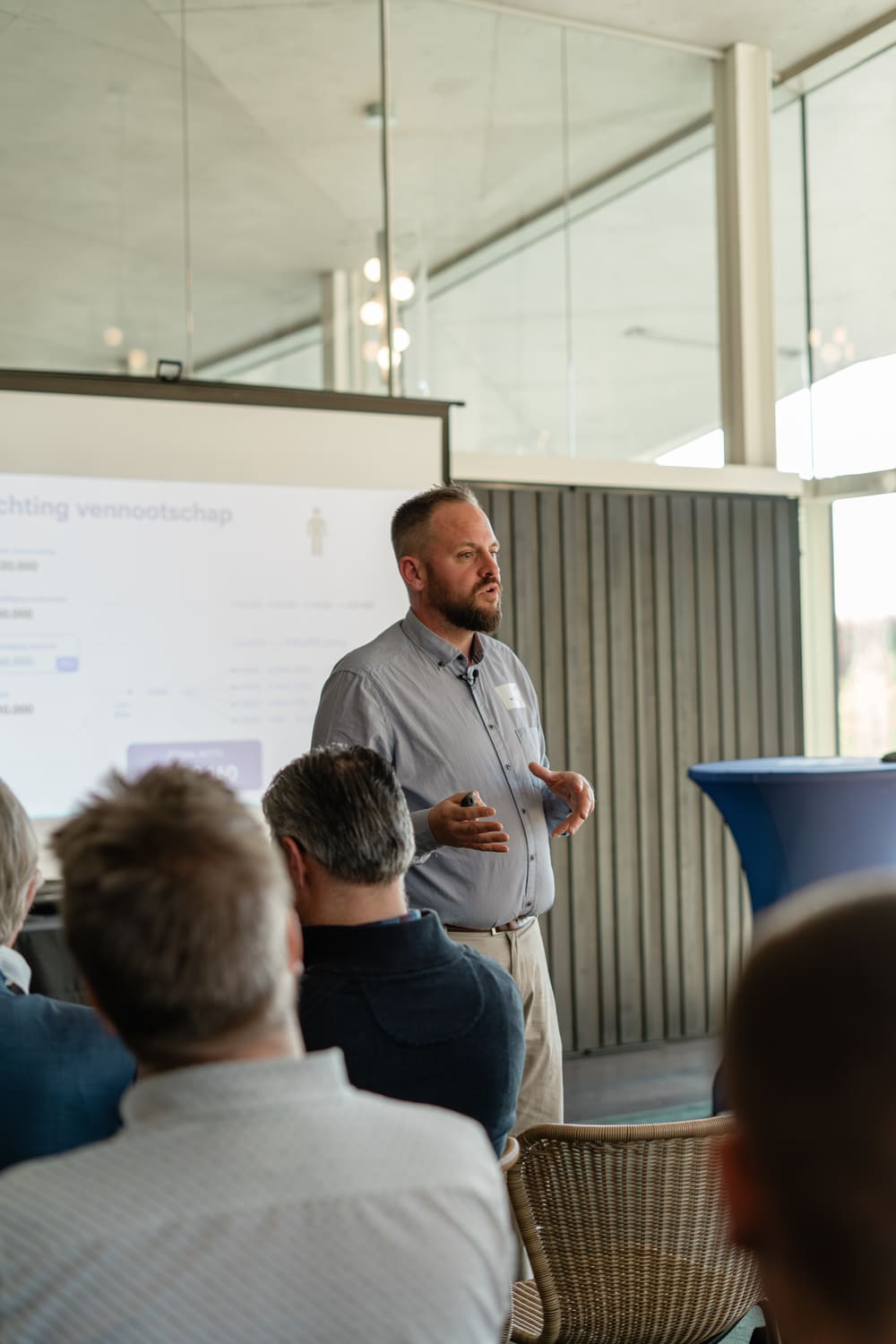
During our seminar in Tielt-Winge, we once again noticed how great this confusion has become today. Not because entrepreneurs are too little interested in taxation, but precisely because they are overwhelmed by fragmented information without clear context. The central question of the evening was therefore deliberately kept simple:
What is actually the smartest way to pay yourself?
That seems like a purely fiscal question, but in reality, it's about much more than just taxes. A good remuneration strategy not only determines how much net money you keep today. It also influences your social protection, your pension accrual, your credit possibilities, your private wealth, and ultimately even your financial peace of mind as an entrepreneur.
Why salary optimization is more important than ever today
Belgium remains one of the countries with the highest tax burden in the world. That is not an ideological statement, but a structural reality that entrepreneurs face daily. During the seminar, therefore, attention was first paid to the broader context. Because many fiscal discussions immediately start from optimization, without ever naming why this pressure has actually become so high.
The Belgian government has been struggling with rising expenditures for years. Pensions, healthcare, social security, and interest charges continue to increase, while their financing becomes increasingly difficult. This creates an environment where entrepreneurs can no longer count on structural fiscal relaxations. On the contrary. There is a greater chance that controls will become stricter, exceptional regimes will be interpreted more narrowly, and the government will actively seek additional income. This makes salary optimization both more relevant and more dangerous. Relevant, because entrepreneurs rightly look for ways to deal with their income more efficiently. Dangerous, because many people consequently start optimizing blindly without considering the sustainability of their choices. A fiscal strategy should never start from one obsession: paying as little tax as possible.
The real question is:
How do you build a financially healthy structure that is efficient today, but still makes sense in ten or twenty years?
And that is a much more complex exercise.
Why standard advice often goes wrong
One of the most striking insights during the seminar was how often entrepreneurs compare themselves to other entrepreneurs. Someone hears that an acquaintance barely pays themselves a salary and works mainly through dividends. Another entrepreneur reads online that IPT would be the "smartest fiscal technique". Yet another receives advice to keep as much money as possible in the company (vennootschap). These techniques are not wrong in themselves. The problem arises when individual strategies are copied without taking personal context into account. Because salary optimization is not a universal formula.
An entrepreneur with high recurring profits, limited private expenses, and a long investment horizon has completely different possibilities than someone who is still in a full growth phase, wants to buy a home, or depends on stable private income. Nevertheless, taxation is often communicated today as if there is one "best solution". That is dangerously simplistic. During the seminar, it was therefore strongly emphasized that a smart remuneration strategy always remains tailor-made. Age, family situation, risk profile, future investments, and personal goals all play a role in the decision.
Whoever reduces taxation to slogans like "dividends are always better than salary" underestimates how complex financial planning truly is.
The pitfall of short-term fiscal thinking
Many entrepreneurs optimize mainly based on what seems fiscally interesting today. That is understandable. The tax burden is high, cash flow remains important, and no one likes to pay more taxes than necessary. But precisely because of this, dangerous reflexes often arise. During the seminar, there was extensive discussion about entrepreneurs who for years focused almost exclusively on tax savings, only to realize later that they had built up insufficient private wealth in the meantime. Everything remained in the company (vennootschap).
On paper, that seemed smart. Taxes were deferred, reserves grew, and the structure looked efficient, until life changed. Suddenly there was a need for private liquidity. A real estate project. A family expansion. A temporary decline in income. Or simply the need for more financial freedom outside the company (vennootschap). And then it becomes clear that a company (vennootschap) is not a private savings account.
Money that has been fiscally "locked up" for years is not always flexibly available when it is really needed. This insight changed the entire way many attendees look at salary optimization. Because taxation is not just about saving. It is also about control, flexibility, and peace of mind.
Are dividends really the smartest solution?
Dividends remain one of the most popular techniques in salary optimization. Understandably so, because in certain situations they can be fiscally very attractive. Nevertheless, during the seminar, it was consciously nuanced why dividends are not automatically the best choice. Many entrepreneurs make the same mistake in thinking: as soon as dividends seem cheaper than salary, they try to keep their salary as low as possible. But this reasoning rarely takes into account the broader consequences.
A structurally low salary can impact your social protection, your pension rights, your creditworthiness, and even your future financial stability. Moreover, it often creates a false sense of efficiency. The cheapest solution today is not necessarily the smartest solution in the long term. This makes salary optimization fundamentally different from pure tax saving.
The goal is not to give away as little as possible. The goal is to build a structure that remains both fiscally efficient and personally sustainable.
Why pension planning is often underestimated
Another important theme during the seminar was pension accumulation for entrepreneurs. Many self-employed people assume that their company (vennootschap) or real estate portfolio will automatically form their pension later. Only a concrete plan is often missing. What is striking is that entrepreneurs usually think very strategically about their business, but invest remarkably little time in their personal financial future.
Pension accumulation is postponed. Decisions are deferred. And meanwhile, fiscal products accumulate without clear coherence. That is why during the seminar it was not only explained how systems such as IPT (Individual Pension Commitment) and VAPZ (Free Complementary Pension for Self-employed Persons) work, but above all why these products are merely tools within a broader strategy.
Because a fiscally attractive pension product has little value when someone doesn't understand:
- what return is realistic
- what cost structure is associated with it
- how flexible the capital remains
- and how the product aligns with personal goals.
This lack of clarity causes many entrepreneurs to drop out as soon as conversations become too technical. This sentence actually perfectly summarizes what many entrepreneurs are looking for today. No complicated fiscal language. No theoretical constructs. Not another course from someone who doesn't understand how financial products work themselves. But understandable explanations with which they can make better decisions themselves.
Why simplicity is often more powerful than complexity
The financial sector has for years sold complexity as a form of expertise. The more difficult something sounded, the more professional it seemed. But during the seminar, the opposite became clear. A strong financial strategy should not sound impressive. It must be understandable. Because as soon as an entrepreneur still doesn't exactly understand after a conversation:
- why a particular structure was chosen
- how the remuneration works
- what risks are involved
- or what impact a decision has in the long term
…then something fundamentally went wrong in the communication.
That does not mean that taxation is simple. On the contrary. But explaining complex subject matter clearly is precisely the essence of good advice.
The true meaning of salary optimization
What ultimately emerged most strongly during the seminar is that salary optimization is often misunderstood. Many people associate it exclusively with saving taxes. But in reality, it is about something much more fundamental. About freedom.
Freedom to build private wealth. Freedom not to be dependent on accidental fiscal rules. Freedom to make financial choices without constant uncertainty. A good remuneration strategy not only helps entrepreneurs work more efficiently today. It also creates long-term peace of mind. And precisely because of this, clear financial education remains so important. Because entrepreneurs today don't need even more complicated fiscal theories. They need clarity. Context. And strategies that not only sound fiscally smart, but also truly work in daily life.
The next step for your company (vennootschap)
Saving taxes as an entrepreneur remains important. Of course. But whoever reduces salary optimization to a quest for the lowest tax bill often misses the bigger picture. The smartest remuneration strategy is rarely the most extreme. It is usually the one that balances taxation, flexibility, pension accumulation, private wealth, and a long-term vision. That requires nuance. That requires strategy. And above all: clear explanation.
That is exactly why we at Lyff. organize seminars and training courses on topics such as salary optimization, pension planning, and financial strategy for entrepreneurs.
Because complex financial matters do not need to be explained in a complicated way.